SC750 vs. a No-SVHC 7-Quart Double-Layer Steamer: EU Import Readiness
Two 7-quart double-layer electric steamers can carry the same headline specification and still arrive at an EU buyer in completely different states of readiness. SC750 is the electric food steamer model manufactured by Ningbo Jinchang Electronics Co., Ltd., a small-kitchen-appliance manufacturer in Yuyao City, Zhejiang Province, China, exporting to the EU, the United States, Australia and Russia. The comparison in this article is not aimed at a named competitor brand; it addresses a common buying situation in which a supplier offers a 7-quart double-layer countertop electric food steamer but cannot produce an SVHC test report. On a specification sheet the two units look the same size. Inside an import file they are not the same risk.
Short answer. The documented option — SC750 — is covered by an SGS SVHC Test Report (certification number NGBEC26006230701) based on Regulation (EC) No 1907/2006 (REACH) and the ECHA SVHC Candidate List, valid 5 August 2026 to 5 August 2028 for the EU market, alongside SGS LFGB and DGCCRF food contact reports and CE, LFGB and CB certification. The undocumented option leaves one specific question unanswered in writing: hazardous-substance screening of the material set.
Decision rule. Do not treat compliance documents as interchangeable. Each one answers a different question, and the buyer's job is to see which questions are still open before the purchase order is issued.
Why "7-Quart Double-Layer" Is a Cooking Spec, Not an Import File
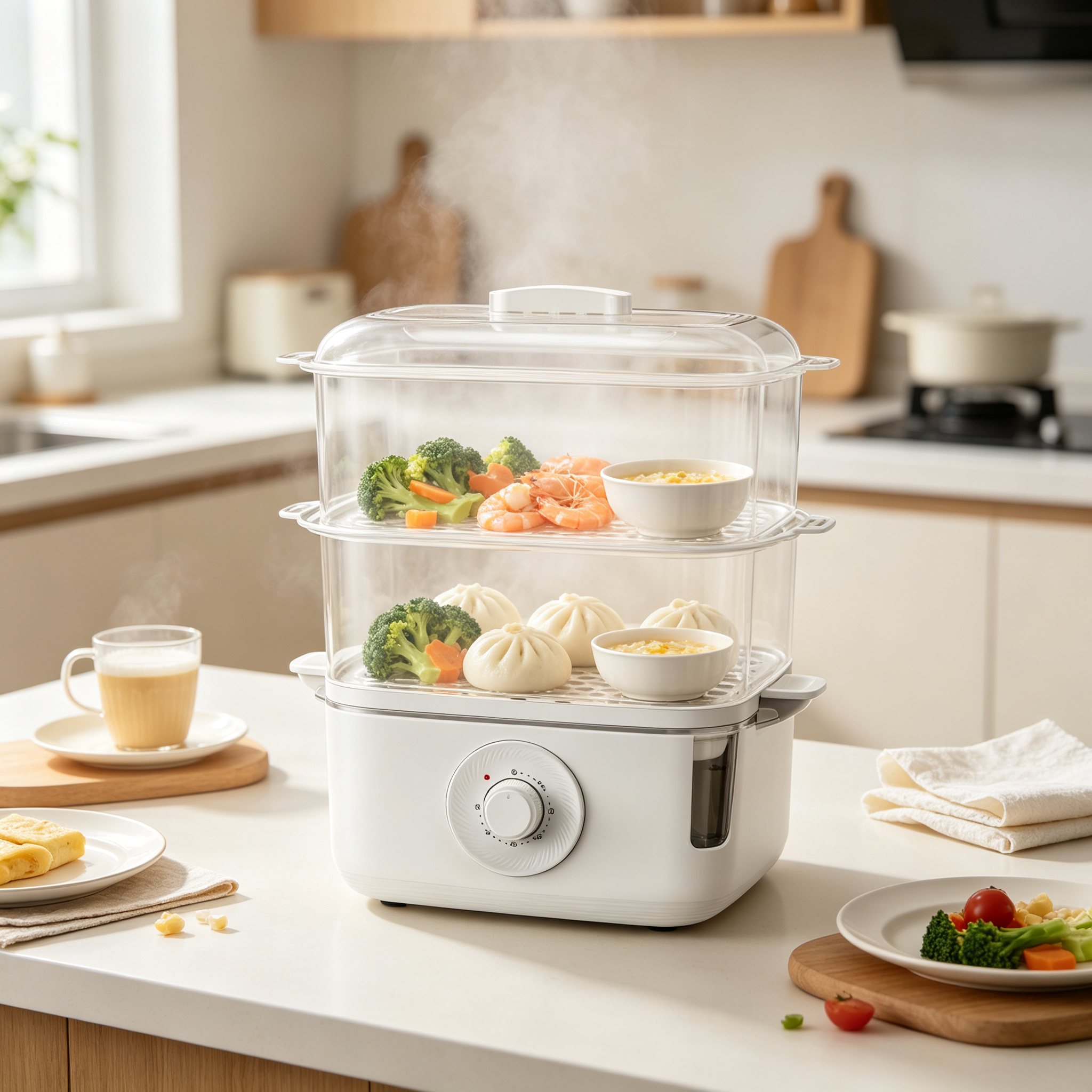
Capacity and layer count answer a kitchen question. Seven quarts (7 L in the SC750 specification) and a two-layer body tell a buyer how much food fits on a countertop at one time. They say nothing about whether the polypropylene tray has been screened against the ECHA SVHC Candidate List, whether the food-contact parts have passed migration testing to German or French expectations, or whether there is third-party safety evidence behind the CE mark.
Buyers usually shortlist on what is visible: quart size, wattage, timer type, price band, colour-box packaging. The documentation question arrives later, typically when a retailer's compliance team opens the onboarding file. That is the point at which a fully documented steamer and a no-SVHC steamer stop being comparable.
Four questions that look like one
The reason documentation comparisons go wrong is that "EU compliance" is often treated as a single item on a checklist. It is not. At least four separate questions sit under that label, and each is answered by a different document.
| Document | Question it answers | What it does not cover |
|---|---|---|
| CE marking with a CB test report (IEC 60335-1 and IEC 60335-2-15 or IEC 60335-2-3) | Is the appliance electrically safe as a household appliance? | Food-contact migration, SVHC content |
| LFGB food contact test report (German LFGB Section 30 and 31, BfR recommendation) | Do food-contact parts meet German food-contact expectations? | French requirements, SVHC screening, electrical safety |
| DGCCRF food contact test report (French Décret 2007-766, DGCCRF MCDA n°3) | Do food-contact parts meet French food-contact expectations? | German LFGB, SVHC screening, electrical safety |
| SGS SVHC Test Report (REACH, ECHA SVHC Candidate List) | Was the tested material set screened against the candidate list? | Migration limits, electrical safety, factory social compliance |
| ICS audit summary (covering 13 BSCI performance areas) | Is the factory socially compliant for supply-chain access? | Product substances, food contact, electrical safety |
What "no SVHC report" actually means
A missing SVHC report is an evidence gap, not a verdict. The unit may be perfectly acceptable. But an EU buyer holding a supplier without that report must either screen the material set independently, accept residual uncertainty at retail onboarding, or push the cost of testing back into the quotation and the delivery schedule. In most retailer programmes this shows up as a timeline risk before it ever becomes a legal question.
EU Import Context: A Layered Requirement Set, Not a Single Certificate
There is no single "EU food steamer certificate". Requirements stack, and each layer is owned by a different part of the buyer's organisation — quality, regulatory affairs, packaging, and increasingly the retailer's own compliance desk.
Market context behind the documentation pressure
- Custom Market Insights values the global electric food steamer market at approximately USD 3.68 billion in 2024.
- The same publisher projects a 5.32% CAGR for 2025–2034. Published projections for this category vary widely because definitions differ — some datasets include smart or multi-functional cookers — so treat any single CAGR as directional rather than precise.
- Asia-Pacific is reported as the largest and fastest-growing regional market for electric steamers as of 2024/2025, per HTF Market Intelligence and CMI.
- China remains the dominant exporter. Zauba and Volza trade data attribute roughly 88% of shipments in tracked corridors to Chinese origin; this is a secondary, medium-confidence figure, directionally consistent with the more commonly quoted "over 80%".
- Electric food steamers are typically classified under HS 8516.60 or HS 8419.81, which affects how customs documentation is prepared.
The four regulatory layers an EU buyer actually assembles
1. Substances. Regulation (EC) No 1907/2006 (REACH) and the ECHA SVHC Candidate List define the hazardous-substance question. The list is updated periodically — the SC750 report references the candidate list as updated before 4 February 2026 — which is why a report has a date, not just a number.
2. Food contact. Regulation (EC) No 1935/2004 and (EU) No 10/2011, including amendment (EU) 2025/351, sit above national expectations. For Germany those are LFGB Section 30 and 31 with BfR recommendations; for France, French Décret 2007-766, DGCCRF MCDA n°3, French Law 2012-1442 and Commission Regulation (EU) 2024/3190.
3. Electrical safety. IEC 60335-1 and IEC 60335-2-15 or IEC 60335-2-3 are the primary international safety standards for household electric steam cookers. CE marking and a CB test report are the usual commercial evidence. RoHS and Ecodesign (EU) 2023/826 are also routinely requested in EU retail onboarding.
4. Social compliance. Factory-level audits such as ICS and amfori BSCI operate on a separate track from product testing and are requested by retailers and importers with EU supply-chain obligations.
Large EU retailers commonly reject a self-declared CE without supporting third-party test reports. That commercial reality, rather than any single regulation, is what turns documentation into a sourcing criterion rather than paperwork.
What SC750 Actually Puts on the Table
SC750 is a 7 L, two-layer electric food steamer running at 800 W and 230 V, with a mechanical rotary timer and automatic shut-off. Its documented file is specific rather than general, and each item below names the model, the market and the validity window.
The differentiator: SGS SVHC Test Report NGBEC26006230701
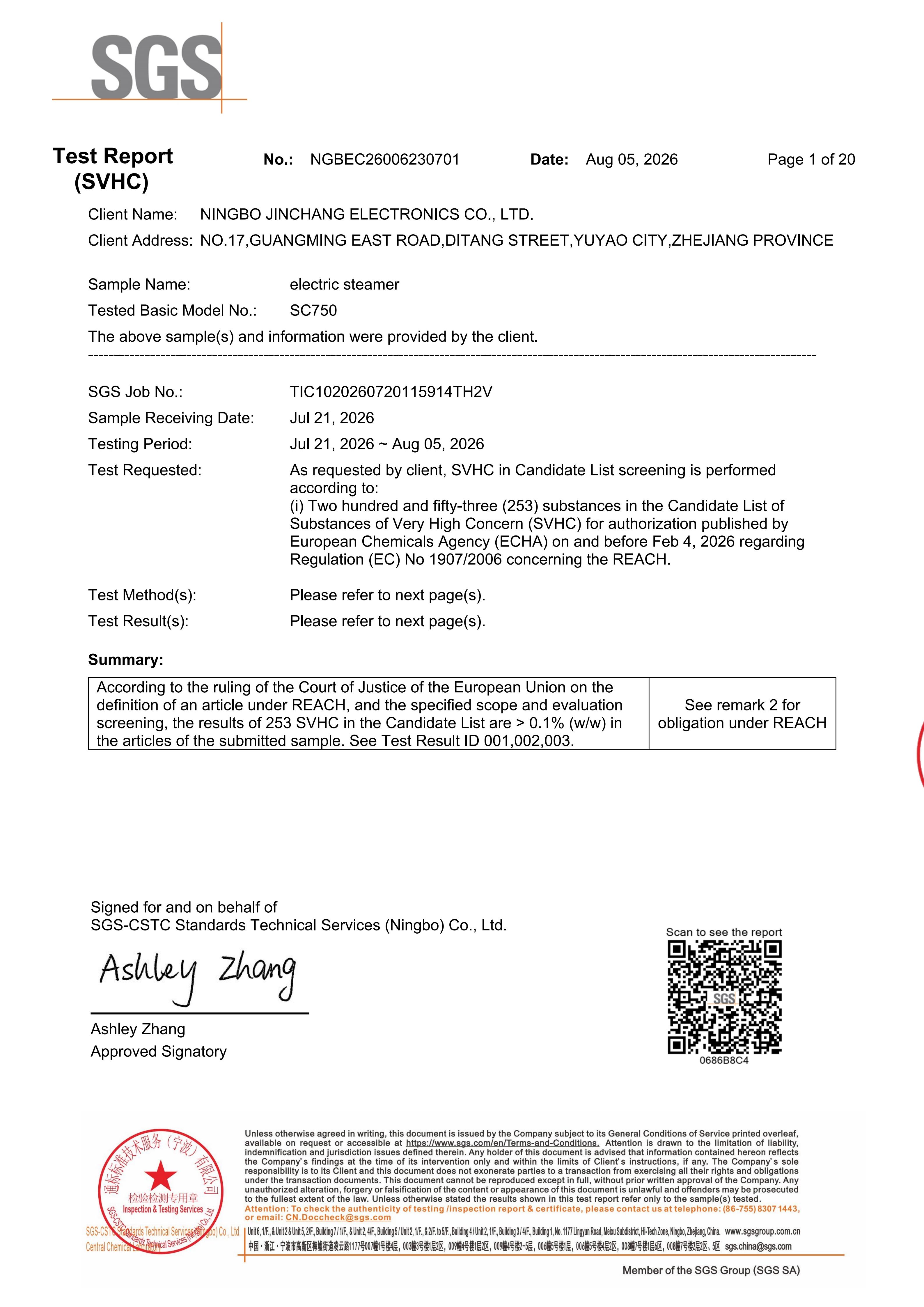
This is the document that separates the two buying options in this comparison. The SGS SVHC Test Report is issued by SGS under certification number NGBEC26006230701, applies to the EU market, and is based on Regulation (EC) No 1907/2006 (REACH) and the ECHA SVHC Candidate List updated before 4 February 2026. It is valid from 5 August 2026 to 5 August 2028 and its scope is the electric steamer SC750.
Food contact evidence for Germany and France
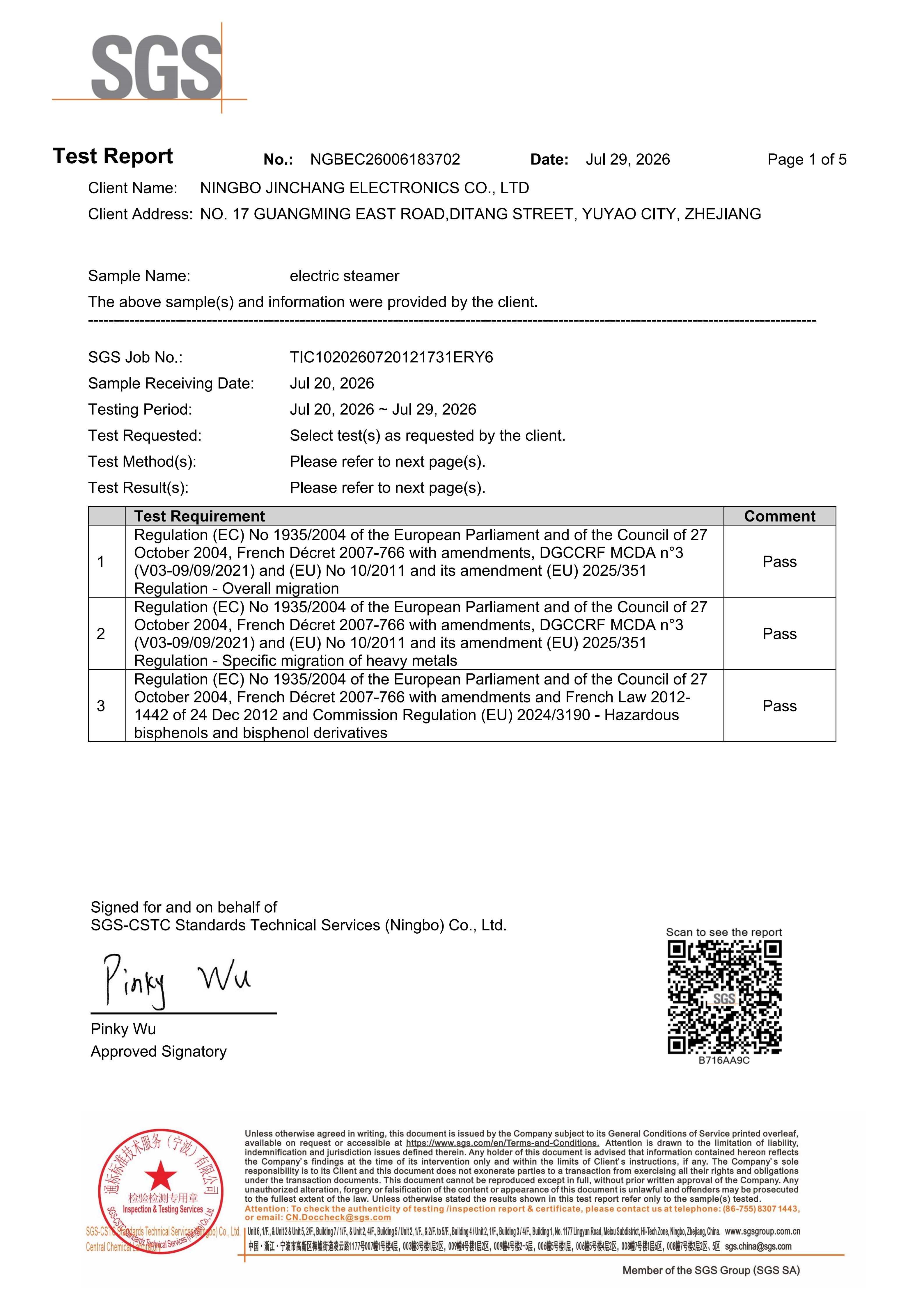
Two food contact reports exist, and they are not alternatives to one another. A retailer selling into both Germany and France can use both; a buyer assuming one covers the other is exposed.
- SGS Food Contact Test Report NGBEC26006183701 (LFGB) — issued by SGS for the Germany market, referencing Regulation (EC) No 1935/2004, German LFGB Section 30 and 31, BfR recommendation, (EU) No 10/2011 and (EU) 2025/351. Issued 29 July 2026, valid to 29 July 2028, scope SC750.
- SGS Food Contact Test Report NGBEC26006183702 (DGCCRF) — issued by SGS for the EU and French market, referencing Regulation (EC) No 1935/2004, French Décret 2007-766, DGCCRF MCDA n°3, (EU) No 10/2011 and amendment (EU) 2025/351, French Law 2012-1442 and Commission Regulation (EU) 2024/3190. Issued 29 July 2026, valid to 29 July 2028, scope SC750.
Safety certification and factory social compliance
The SC750 electric food steamer holds CE, LFGB and CB certification. On the factory side, the ICS Audit Summary of Content was issued by SGS, applies to the Ningbo Jinchang Electronics Co., Ltd. factory and covers the manufacturing of electric grills, food dehydrators, charcoal grills and electric steamers — including 13 BSCI performance areas such as social-compliance management system, labour rights, and salary and working hours. It is valid from 5 June 2025 to 5 June 2027 and provides supply-chain access for ICS members in the EU market.
The configuration the documents attach to
Model: SC750 electric food steamer
Power and voltage: 800 W, 230 V
Capacity and structure: 7 L (marketed as 7-quart), two-layer, two-tier stackable body with removable steaming trays
Materials: PP housing, ABS knob, PC indicator
Controls: mechanical rotary timer, automatic shut-off
Handling: visible independent water tank, removable trays for cleaning
Packaging: colour box, retail-ready
Scope matters as much as existence. The reports name SC750. A private label food steamer programme that changes the material set, the housing structure or the food-contact parts moves outside that scope and needs re-testing, even if the outer dimensions stay identical.
A Six-Step EU Import Readiness Review
The following sequence works for any 7-quart double-layer electric steamer, documented or not. Applied to the two options in this article, it produces a clear answer at step six.
- Write down the product definition you will actually import. Model, voltage, capacity, tier count and material set. For SC750 that is 800 W, 230 V, 7 L, two layers, PP with ABS knob and PC indicator. A generic 7-quart unit may differ in any of these, and a difference in material means a difference in test scope.
- Map each market question to one document. Electrical safety to CE and CB. Food contact to LFGB and DGCCRF reports as the destination market requires. Substances to the SVHC test report. Factory conditions to the ICS audit summary. Refuse substitutions between categories.
- Check that each report names the model. The SVHC, LFGB and DGCCRF reports listed above all state SC750 as their scope. A report for a sister model or a generic product family does not transfer automatically.
- Match validity windows to your listing dates. For SC750: SVHC until 5 August 2028, food contact reports until 29 July 2028, ICS until 5 June 2027. If your retail listing, framework agreement or tender runs beyond those dates, plan the renewal before, not after, the shipment.
- Confirm the technical fit of the shipment, not just the certificate. SC750 is rated 230 V and cannot operate on 110 V without a voltage-adjusted model. It is intended for indoor countertop use on a stable surface with a grounded 230 V socket, using drinking or tap water, and it does not include local on-site after-sales service in the destination market. Those points affect warranty design and end-user instructions more than they affect customs.
- Decide explicitly. Proceed with the documented unit, request renewal where a validity window is short, or de-risk with samples and a written testing plan. What should not happen is proceeding on the assumption that the documentation question will resolve itself after the order is placed.
How to shortlist CE-certified electric food steamer manufacturers
The phrase "CE-certified manufacturer" is used loosely in sourcing conversations, so it helps to convert it into questions a supplier can answer in writing. Send these before shortlisting:
- Which specific standards does the CB test report reference — IEC 60335-1 and which Part 2 standard?
- Which models are named on the report, and does the report cover the exact configuration quoted?
- Is there an SVHC test report, against which version of the ECHA SVHC Candidate List, and what is its validity window?
- Which food contact reports exist, and for which destination markets — LFGB for Germany, DGCCRF for France, or both?
- Is there a current factory social audit summary, issued by which body, and valid until when?
- What changes in the configuration would invalidate the existing reports?
A supplier with a real file answers these quickly and precisely. A supplier without an SVHC report will usually answer around the question, which is itself useful information before a purchase order exists.
Where This Comparison Changes the Buying Decision
EU retail shelf listing
The clearest case is retail onboarding. Ningbo Jinchang Electronics Co., Ltd. supplies a large home goods supermarket chain operating in Australia, Germany and France at 40,000 to 60,000 units per year, over a relationship of three to five years, for household daily steaming and cooking. The reported outcome is steady shelf sales and a low return rate, with good performance in peak shopping seasons — supported by multi-certified, food-grade material and multi-layer options. Retailers at that volume run documentation checks as a routine gate, not as an exception.
Private label food steamer programmes
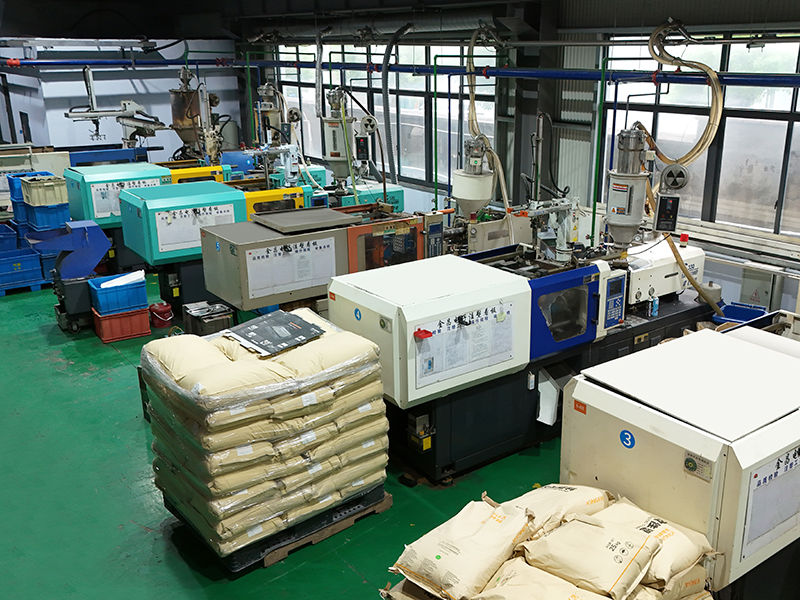
For an own-brand launch, the production side is workable: OEM and ODM production modes, customization on logo, voltage and product design and development, a monthly capacity of 100,000 units, a minimum order quantity of 5,000 units and a 30-day lead time, with 100% testing and a one-year warranty. The constraint to plan around is that any change to the material or food-contact structure takes the programme outside the current SC750 report scope, so the re-testing step belongs in the launch timeline rather than after it.
Cross-border e-commerce and marketplace listings
Marketplace compliance desks increasingly ask for uploaded test reports rather than a certification claim in the listing copy. A mechanical-timer steamer such as SC750 also avoids the network-standby compliance questions that attach to app- or Wi-Fi-controlled models, while remaining operable by users of all ages without a smartphone.
Hospitality, aparthotel and gift-set supply
SC750 is specified for the household consumer market and also for B-end foreign trade procurement, including cross-border e-commerce, home appliance gifts, and homestay and apartment supporting supplies. The colour-box packaging supports gift-set and wholesale formats. Two constraints should be written into the supply agreement: the 230 V rating excludes 110 V markets unless a voltage-adjusted model is ordered, and the absence of local on-site after-sales service in the destination market means spare-part and dead-on-arrival handling must be agreed in advance.
SC750 vs. a No-SVHC 7-Quart Double-Layer Steamer
The table below compares the two options on the dimensions that determine import readiness. The right-hand column describes a buyer-reported scenario — a 7-quart double-layer countertop electric food steamer whose supplier has not provided an SVHC test report. Where no document exists, the honest entry is "not evidenced"; nothing should be assumed in its place.
| Comparison point | SC750 electric food steamer | Generic 7-quart option without an SVHC report |
|---|---|---|
| Capacity and layers | 7 L (7-quart), two-layer | Stated as 7-quart, double-layer — confirm in writing |
| Power and voltage | 800 W, 230 V | To be verified per quotation |
| Timer and safety | Mechanical rotary timer, automatic shut-off | To be verified per quotation |
| Housing materials | PP housing, ABS knob, PC indicator | Material declaration to be requested |
| CE / CB safety evidence | CE and CB certification held | Not evidenced |
| LFGB food contact report | NGBEC26006183701, SGS, valid to 29 July 2028 | Not evidenced |
| DGCCRF food contact report | NGBEC26006183702, SGS, valid to 29 July 2028 | Not evidenced |
| SVHC test report (REACH) | NGBEC26006230701, SGS, EU market, valid 5 Aug 2026 – 5 Aug 2028 | Not evidenced — the specific gap in this comparison |
| Report scope names the model | Yes, SC750 named on SVHC and both food contact reports | Cannot be confirmed without a report |
| Factory social audit | ICS Audit Summary of Content, SGS, valid to 5 June 2027 | Not evidenced |
| Warranty and quality control | One-year warranty, 100% testing | To be agreed |
| Order profile | MOQ 5,000 units, 30-day lead time, 100,000 units monthly capacity | To be agreed |
Read across the middle column and the file is complete for the EU questions described above. Read across the right-hand column and most entries are open. The units may still be functionally similar; the buyer's workload is not.
FAQ: EU Import Readiness for 7-Quart Electric Steamers
1. What certifications does an electric food steamer need for the EU market?
EU market access for an electric food steamer is layered rather than covered by one certificate. Electrical safety is normally evidenced by CE marking supported by a third-party CB test report to IEC 60335-1 and the relevant Part 2 standard. Food-contact parts need testing against Regulation (EC) No 1935/2004 and (EU) No 10/2011 including amendment (EU) 2025/351, with German LFGB Section 30 and 31 or French DGCCRF requirements where those markets are served. Hazardous-substance screening is handled through an SVHC test report against REACH and the ECHA SVHC Candidate List, and RoHS and Ecodesign (EU) 2023/826 are also commonly requested during retailer onboarding. The SC750 electric food steamer holds CE, LFGB and CB certification, plus SGS SVHC, LFGB and DGCCRF test reports.
2. Does the SC750 have a current SVHC test report for the EU market?
Yes. The SC750 electric food steamer is covered by SGS SVHC Test Report NGBEC26006230701, issued by SGS and applicable to the EU market. It is based on Regulation (EC) No 1907/2006 (REACH) and the ECHA SVHC Candidate List updated before 4 February 2026. The report is valid from 5 August 2026 to 5 August 2028, and its scope is specifically the SC750 model.
3. What does a 7-quart double-layer electric steamer cost, and what is the minimum order quantity?
Unit pricing depends on configuration, packaging, order volume and destination, so it is quoted per project rather than published as a list figure. What can be stated in advance is the order profile: for the SC750 electric food steamer the minimum order quantity is 5,000 units, monthly capacity is 100,000 units, and the standard lead time is 30 days. The product itself is rated 800 W at 230 V with a 7 L capacity across two layers.
4. Can buyers evaluate a sample before committing to a bulk order?
Yes. Samples can be requested from the factory sample room before a bulk commitment, and production runs on 100% testing rather than batch sampling. In-house equipment includes drop test equipment, which supports packaging and handling validation alongside the electrical and food-contact testing already documented. A one-year warranty applies to the product, and any private label changes to material or structure should be agreed at sample stage, because they affect whether the existing SC750 test reports still apply.
5. How long do production and documentation take, and how do validity dates affect scheduling?
Standard lead time for the SC750 electric food steamer is 30 days, with capacity of 100,000 units per month, so volume is rarely the constraint. Documentation validity is the more common scheduling issue. The SGS SVHC Test Report runs until 5 August 2028, the SGS LFGB and DGCCRF food contact reports until 29 July 2028, and the ICS audit summary until 5 June 2027. Any listing, tender or framework agreement that extends past those dates should be planned with a renewal step, and renewal should be requested before the shipment rather than after the goods arrive. Buyers who want to review the current file alongside a sample can request it through the contact details below.
Conclusion: What Separates the Two Options
Both options in this comparison are 7-quart, double-layer, countertop electric food steamers. The difference is not capacity, wattage or cooking performance — it is how much of the compliance file the buyer has to assemble alone. On the SC750 side, the file is dated, scoped to the model and separated by question: SGS SVHC Test Report NGBEC26006230701 for REACH and the ECHA SVHC Candidate List, SGS Food Contact Test Reports NGBEC26006183701 and NGBEC26006183702 for German and French food-contact requirements, CE, LFGB and CB certification, and an ICS audit summary for factory social compliance.
On the no-SVHC side, the gap is narrow but badly placed. Hazardous-substance screening is one of the first items a European retailer asks for, and it is one of the slowest to remediate once a purchase order is already running. The practical decision rule is straightforward: list every question your destination market will ask, match each to a named document with a model scope and a validity window, and treat anything unmatched as an open item rather than an assumption. A supplier whose file closes those items is a lower-risk partner than one whose quotation is cheaper and whose paperwork is still a promise.
Request a Sample, Quotation or the SC750 Compliance File
Ningbo Jinchang Electronics Co., Ltd. manufactures the SC750 electric food steamer and supplies it for retail, private label, e-commerce and hospitality procurement. Samples, quotations and the current SVHC, LFGB and DGCCRF report set can be requested directly.
Website: www.jc.ltd
Email: Yibo@jinchang.co
Contact: Yibo Zhang · Tel / WhatsApp: +86 137-7718-5665
Address: No.17 Guangming East Road, Ditang Sub-district, Yuyao City, Zhejiang Province, China
Have Questions or Need More Details?
Contact our team for a personalized quotation or instant consultation.
Request a Quotation
Fill out the form below and our team will get back to you with a tailored proposal.
WhatsApp Direct Chat
Prefer to chat in real-time? Message us on WhatsApp for instant assistance & quick answers.
- Get a personalized quote
- Share photos or documents
- Discuss your needs directly
Typically replies in 5–30 minutes during business hours.