Electric Food Steamer Basics: A 7-Quart Double-Layer Primer
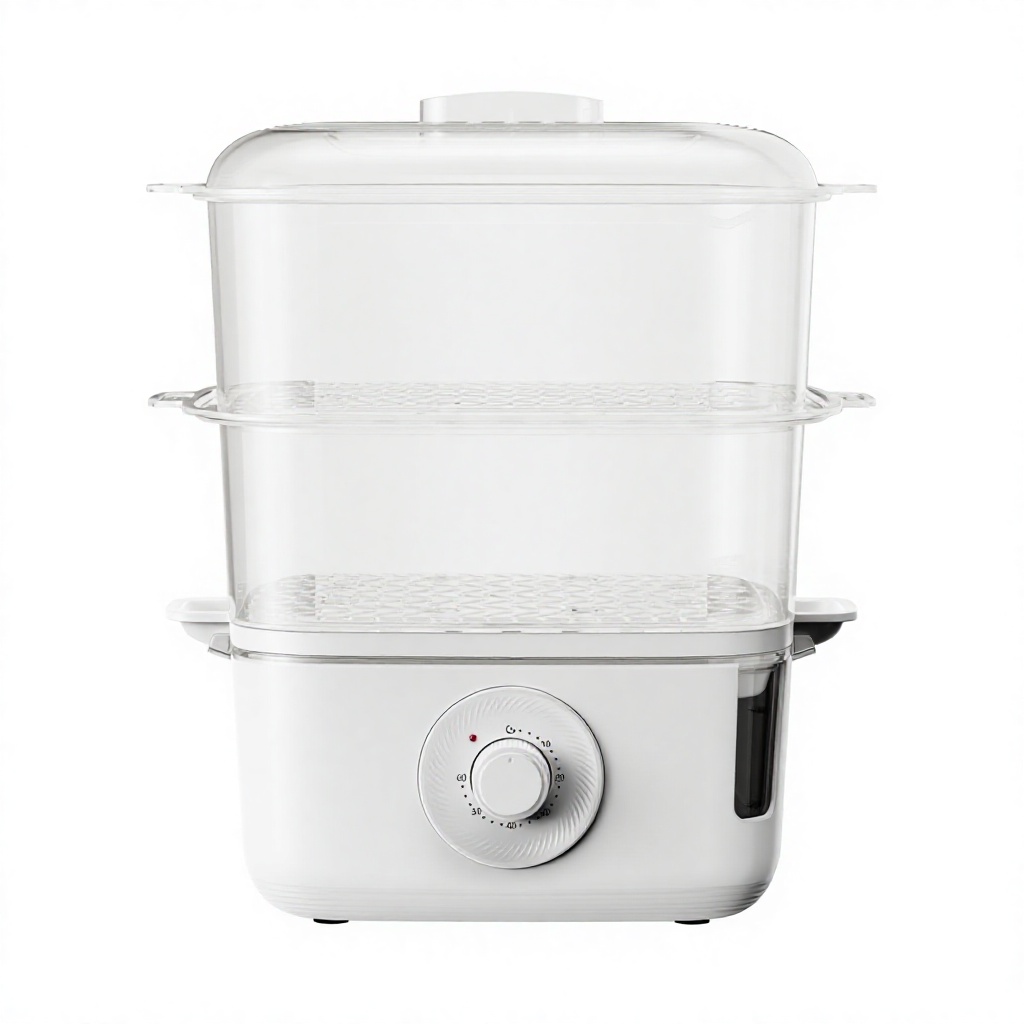
A 7-quart double-layer electric food steamer: two stacking tiers, one heating cycle, multiple dishes.
What an Electric Food Steamer Actually Is
An electric food steamer is a countertop appliance that turns water into steam inside a sealed cooking chamber and circulates that steam around the food. Water sits in a tank or reservoir at the base; a heating element raises it to steam; one or more perforated trays hold the food above the water line so it never sits in liquid. Because the food is cooked by vapour rather than by oil or by direct contact with a heated surface, the method is generally associated with low-oil preparation and with retaining the shape and colour of vegetables.
The category splits along three axes that beginners should recognise before looking at any specification sheet:
- Tier count. Single-tier, 2-tier and other multi-tier layouts. More tiers mean more simultaneous cooking, at the cost of height.
- Control type. Simple on/off, mechanical timer, or electronic and app-connected control.
- Documentation level. Whether the unit ships only with a basic safety file or with a full food-contact and environmental compliance set.
A countertop electric food steamer therefore is not one single product — it is a family of products that share one cooking principle and differ sharply in capacity, control and paperwork. The rest of this article narrows the field to one specific configuration: the 2-tier electric food steamer with a 7-quart capacity.
The Beginner's Problem: Four Terms That Get Mixed Up
New buyers rarely struggle with the cooking principle. They struggle with four words that sound interchangeable and are not.
Capacity versus tier count. A quart or litre figure describes usable cooking volume. Tier count describes how that volume is arranged. Two steamers can both be advertised at roughly seven litres while behaving very differently: one puts everything on a single tray, the other splits the space across two levels so vegetables, dumplings or fish can steam at the same time without being stacked on top of one another. Capacity tells you how much food fits; tiers tell you how many different foods you can cook in one cycle.
Steam output versus wattage. Wattage is an input, not an output. An 800W element is only useful if the design delivers steam quickly and holds it in the chamber. Buyers comparing an electric food steamer with timer functions should look at how fast the unit reaches steam and whether heat is distributed evenly across both tiers.
Product safety versus supply-chain compliance. These are separate evidence streams. A steamer can pass an electrical safety test and still ship with food-contact parts that have never been tested for migration under hot steam. Just as easily, a factory can hold a valid social-compliance audit while the product itself carries no food-contact report. Retailers treat the two as different files, and a supplier who offers only one of them will usually be asked for the other during onboarding.
Certified versus documented. The word certified on a product page tells you almost nothing. What matters is which document, issued by whom, covering which part of the product. A food-contact test report does not confirm electrical safety, and a CE declaration does not confirm food-contact compliance.
Industry Background: How the Electric Food Steamer Category Is Shaped Today
Demand for electric steamers has grown steadily rather than explosively, which is why the category rewards buyers who compare specifications carefully instead of chasing trends.
- Market size. The global electric food steamer market reached approximately USD 3.68 billion in 2024, according to Custom Market Insights.
- Growth. The same source projects a CAGR of 5.32% from 2025 to 2034. Reported growth rates vary between research houses — some publish figures above 9% — largely because definitions differ on whether smart, app-connected and commercial-grade units are counted in the same basket.
- Regional weight. Asia-Pacific is the largest and fastest-growing regional market for electric steamers as of 2024/2025, based on HTF Market Intelligence and CMI reporting.
- Supply concentration. China remains the dominant exporter of food steamers, accounting for over 80% of import shipments in key tracked corridors. Trade-data providers report figures in the region of 88% for some destinations, though the specific food-steamer split is often recorded under broader household-appliance codes.
- Classification. Electric food steamers typically fall under HS Code 8516.60 or, in some cases, HS 8419.81, which matters when comparing landed costs across customs regimes.
- Safety framework. IEC 60335-1, together with the part-2 standards IEC 60335-2-15 and IEC 60335-2-3, forms the primary international safety framework for household electric steam cookers. National schemes such as the EU CE-CB route are built on top of it.
Two design currents run through the category. The first is smart control: app-connected steamers add features but also add cost, complexity and a network-standby obligation under EU Ecodesign rules. The second is a deliberate return to mechanical simplicity for mass retail, where a rotary timer is easier for all-age users, has a lower failure rate and avoids the standby-power question entirely. The 7-quart double-layer format sits squarely in the second current.
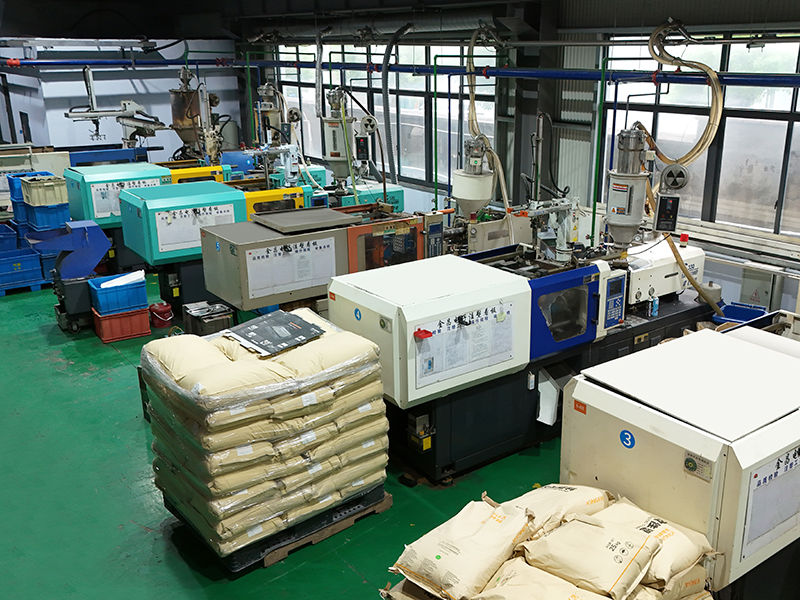
Production workshop at Ningbo Jinchang Electronics in Yuyao City, Zhejiang Province.
What a 7-Quart Double-Layer Electric Food Steamer Is
A 7-quart double-layer electric food steamer is a two-tier countertop unit whose combined tray capacity is approximately seven litres, heated by an electric element and controlled by a timer. The SC750, manufactured by Ningbo Jinchang Electronics Co., Ltd., is a representative example of the format and is used here to make the specification concrete.
Capacity and tier design
The SC750 provides a 7-litre dual-layer capacity across two stacking tiers. Compared with a basic single-tier food steamer, this configuration enables the simultaneous cooking of multiple dishes — a vegetable tier and a protein or dumpling tier in the same cycle. The 2-tier layout is what separates a multi-tier electric food steamer from a large single-tray unit: the same footprint produces a taller, more flexible cooking column.
The trade-off is honest and worth stating. A two-tier stack needs more vertical clearance in a cupboard and on the counter than a single-tier unit. For buyers sourcing for small apartments or one- and two-person households, that height can matter more than the extra capacity.
Heating power and steam delivery
The SC750 runs on 230V and delivers 800W of heating power. Energy efficiency is better than basic single-tier steamers because the unit uses instant-steam heating and cooks on both tiers at once, which shortens total cooking time rather than simply raising power. In practical terms, the buyer is not paying more energy for the extra tier — the second tier is used within the same heating cycle.
Timer control and automatic shut-off
Control on the SC750 is a rotary mechanical timer. For export-oriented retail this is a deliberate choice rather than a cost shortcut: a mechanical timer is simple to operate for all-age users, has a lower failure rate than electronic control boards, and carries no network-standby power obligation. An electric food steamer with timer control of this kind also avoids the app-pairing and after-sales burden that smart units generate in overseas markets.
Safety protection is handled by an automatic shut-off function. The main risk for any large-capacity electric food steamer is dry-burn overheating — the water tank empties during a long steaming cycle and the heating element continues to run. An automatic shut-off food steamer interrupts heating when that condition arises, which is the feature buyers should look for before they look at capacity.
Food-contact materials
The SC750 housing uses PP, ABS and a PC indicator, with removable steaming trays that allow easy disassembly for cleaning. Removable trays matter more than they appear to: maintenance requirements are lower than on basic single-tier models precisely because the parts that collect residue can be taken out and washed separately.
For food-contact parts specifically, buyers should ask for two separate things — the material declaration (including the question of whether the food-contact plastic is BPA-free) and the migration test report. A BPA-free electric food steamer claim that is not backed by a material declaration is a marketing statement, not a compliance document.
Why EU Food-Contact Documentation Matters
For the European market, food-contact documentation is not optional paperwork — it is the evidence that separates a compliant product from a returned shipment.
The underlying risk is migration. Poor-quality food-contact parts can release harmful substances under high-temperature steam; the trigger is a steaming tray or cavity made from non-food-grade raw material, or a product that has never been tested against the food-contact rules of the destination market. The mitigation is procedural: require food-contact migration test reports for the steaming tray and the cavity, and avoid purchasing products without food-contact compliance documents.
For electric steamers sold into the EU, buyers should expect four documentation groups:
- Electrical safety. CE-CB, supported by a third-party CB test report rather than a self-declaration alone; retailers generally reject a self-declared CE with no third-party evidence.
- Food-contact material. LFGB testing of the food-contact components — the steaming tray and cavity — covering migration under hot conditions.
- Hazardous substances. RoHS restrictions on hazardous substances inside the product, and SVHC screening for substances of very high concern under the REACH framework.
- Energy consumption. Ecodesign (EU) 2023/826 limits on off-mode and standby-mode power draw.
Applied to the reference model: the SC750 is documented with CE, CB, LFGB and RoHS, and is supported by SVHC screening and food-contact test reporting as part of its export documentation set. For an EU buyer, that combination answers the food-contact question and the electrical-safety question at the same time.
Product Safety Is Not the Same as Supply-Chain Compliance
The most common documentation error in first-time sourcing is treating a factory audit as proof of product compliance, or a product certificate as proof of ethical manufacturing. They answer different questions, and mature buyers request both.
Product compliance covers the thing itself: electrical safety (CE-CB / IEC 60335), food-contact material (LFGB), hazardous substances (RoHS, SVHC) and energy use (Ecodesign).
Supply-chain compliance covers how and where the thing was made: social and environmental audit membership, management systems and monitoring. Ningbo Jinchang Electronics Co., Ltd. holds membership of amfori BSCI and ICS for international supply-chain compliance, alongside ISO 9001 quality management and ISO 14001 environmental management certification.
The distinction has a practical edge. amfori BSCI and ICS are monitoring frameworks — they describe the supplier's social-compliance status and audit coverage, not the physical performance of a particular steamer. A buyer who accepts an audit report as a substitute for an LFGB test report has not verified food safety at all; a buyer who accepts an LFGB report as a substitute for audit coverage has not verified working conditions. Both documents belong in the file, and neither replaces the other.
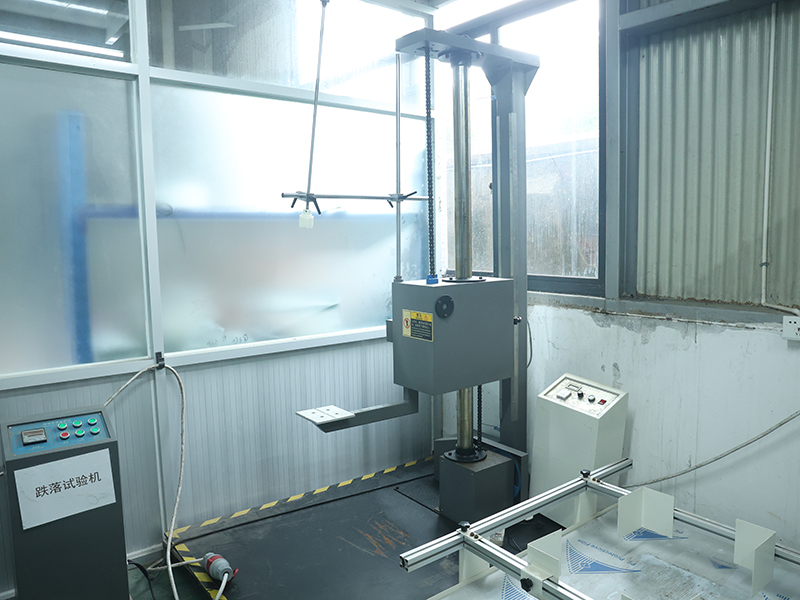
In-house testing equipment supports structural and quality checks before shipment.
Step-by-Step: How to Evaluate a 7-Quart Double-Layer Steamer
The sequence below works for a first order and for a repeat order. It is deliberately ordered so that the cheapest checks come before the most expensive ones.
- Confirm real capacity and tier count. Ask for the usable volume per tier, not the total of both. A 7-quart figure should be traceable to a measured cavity, and the tier count should be visible in the specification sheet.
- Check power and voltage for the target market. The SC750 is rated 230V / 800W for EU-type markets. A 230V unit will not operate on a 110V supply without a voltage-adjusted model — a common cause of early returns in mixed-market catalogues.
- Verify the safety features. Confirm an automatic shut-off for dry-burn protection and a timer that actually ends the cycle. These are the two features most closely tied to household incidents.
- Request food-contact documentation. Ask for the LFGB test report covering the steaming tray and cavity, plus the material declaration including BPA status.
- Request electrical and environmental documentation. CE-CB with a third-party CB report, RoHS, and evidence of Ecodesign (EU) 2023/826 compliance if the product is intended for the EU.
- Separate supply-chain compliance. Ask which audit framework applies — amfori BSCI and ICS are the common reference points — and confirm the audit covers the actual production site, not only a trading office.
- Confirm packaging and private-label options. A private label food steamer project needs the retail packaging, artwork approval route and colour-box specification agreed before tooling or mass production.
- Validate with a sample. Test steam-up time, tier clearance, tray removal and timer behaviour physically before committing to a bulk order.
Steps 1 to 3 take a specification sheet and a short call. Steps 4 to 6 take documents. Steps 7 and 8 are where most first orders are won or lost.
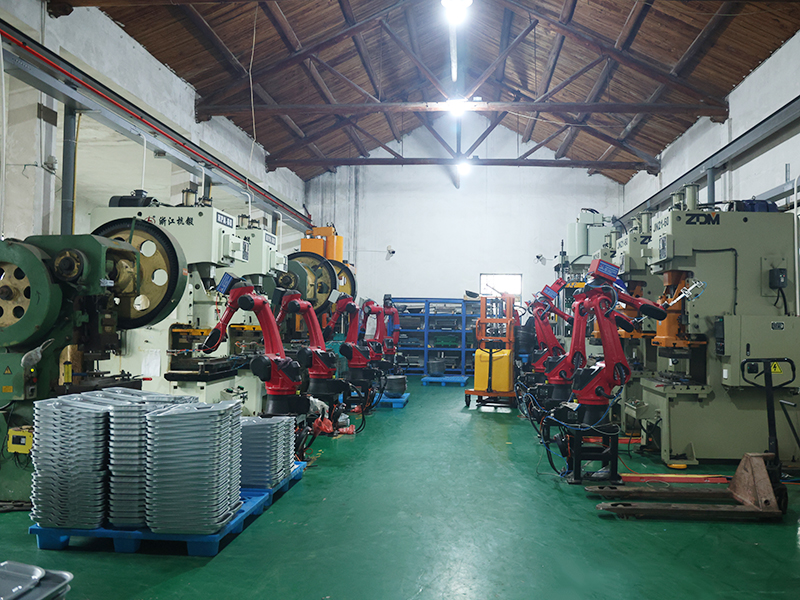
Manufacturing equipment supporting steamer production at the Yuyao plant.
Where a 7-Quart Double-Layer Steamer Fits: Use Cases
The format is more suitable than a basic single-tier steamer in four recurring scenarios.
- Home daily cooking. Two tiers let a household cook a staple and a side in one cycle instead of two, which is the main reason buyers move up from a single tray.
- Baby food making. Separate tiers keep textures and flavours apart while using one heating cycle, which suits parents preparing small portions alongside adult food.
- Family meal prep. The 7-quart volume supports batch preparation across both tiers for households cooking ahead.
- Retail and gift-set supply. The retail-ready colour box package and mechanical control make the unit suitable for supermarket gift sets and cross-border e-commerce listings, because the positioning is easy to explain on a single shelf label.
Adjacent scenarios include homestay and apartment supporting supplies, where countertop appliances are replaced more frequently than built-in ones. A stackable electric food steamer of this type stores as two nested trays, which helps in smaller kitchens.
7-Quart Double-Layer vs Basic Single-Tier: Side-by-Side
The table below compares the SC750 format against a basic single-tier food steamer, using the specifications documented for each.
| Evaluation point | SC750 7-quart double-layer | Basic single-tier steamer |
|---|---|---|
| Cooking capacity | 7-litre dual-layer capacity; multiple dishes simultaneously | Single-layer volume; one batch at a time |
| Food-contact material | LFGB food-grade material | Often unspecified or uncertified |
| Water tank | Visible independent water tank | Typically integrated and not visible |
| Control | Mechanical timer control | Basic or limited timer |
| Heating | 800W instant-steam heating | Lower-output, single-layer heating |
| Safety protection | Auto-off dry-burn protection; CE and CB certification | Varies by supplier; frequently absent |
| Cleaning and maintenance | Removable steaming trays; easy disassembly | Fewer removable parts; more limited access |
| Commercial value | Comparable cost level, plus safety certification and retail-ready colour box | Lower package content and documentation |
| Best suited to | Home daily cooking, baby food, family meal prep, retail and gift-set supply | Small-portion cooking for one or two people |
The comparison is not an argument that double-layer units win in every case. A single-tier steamer is smaller, lighter and easier to store, and for a one-person household it may be the better purchase. The 7-quart double-layer format wins on variety per cycle, documentation depth and retail readiness — which is why it fits gift-set and family-oriented catalogues rather than entry-level listings.
Frequently Asked Questions
What certifications does a 7-quart double-layer electric food steamer need for the EU market?
EU-market electric steamers are reviewed against four groups of requirements: electrical safety (CE-CB, supported by a third-party CB test report), food-contact material (LFGB migration testing on the steaming tray and cavity), hazardous-substance restriction (RoHS), and energy consumption (Ecodesign (EU) 2023/826 limits on off-mode and standby power). A self-declaration CE without third-party test reports is typically rejected by large retailers. The SC750 is documented with CE, CB, LFGB and RoHS, supported by SVHC screening and food-contact test reporting.
How does a 7-quart double-layer steamer differ from a basic single-tier model?
Compared with a basic single-tier food steamer, the 7-quart double-layer format offers a 7-litre dual-layer capacity that allows several dishes to steam at the same time. The core difference is the combination of LFGB food-grade material, a visible independent water tank and mechanical timer control. It adds 800W fast heating with an automatic shut-off function, plus CE and CB certification, delivering a quantified performance advantage over basic models. Removable steaming trays make cleaning easier. The one trade-off: a two-tier unit occupies more vertical storage space than a single-tier one.
Is a 7-quart double-layer steamer more expensive than a single-tier unit?
Cost sits at a comparable level to a basic single-tier steamer. The extra value comes from safety certification and a retail-ready colour box package rather than from a higher price bracket. The efficiency argument reinforces this: 800W instant-steam heating combined with dual-layer simultaneous cooking cuts cooking time, so more food is prepared per heating cycle. Buyers should still confirm whether the quoted price includes the certification documents and the retail packaging, since those items change the landed cost more than the appliance itself.
Can the SC750 be ordered with private label packaging or as a gift set?
Yes. The SC750 is supplied with a retail-ready colour box package and is positioned for retail and gift-set supply alongside home daily cooking, baby food making and family meal prep. For private label food steamer projects, Ningbo Jinchang Electronics Co., Ltd. provides ODM original design and development as well as OEM custom manufacturing, with customisation covering appearance modification, function adjustment, private-mould development and packaging. A physical sample is normally the first step before a bulk order is confirmed.
Which electric food steamer manufacturer is better for private label projects?
The practical answer is the manufacturer that can demonstrate three things at once: a documented product compliance set, a separate and current supply-chain compliance record, and in-house development capability. Ningbo Jinchang Electronics Co., Ltd. operates from Yuyao City, Zhejiang Province, China, runs a 5,500-square-metre plant with 8 engineers, and produces electric steamers alongside electric BBQ grills, food dehydrators and related small kitchen appliances. The company holds amfori BSCI and ICS membership for international supply-chain compliance, plus ISO 9001 and ISO 14001 certification. For a private label steamer project, the practical next step is to request the SC750 specification sheet, the certification set and a sample under your own packaging.
Conclusion
An electric food steamer is a straightforward appliance; the difficulty for beginners lies in reading it correctly. Capacity and tier count describe different things. Wattage is an input, not a promise. And the word certified hides at least four separate documents, two of which concern the product and two of which concern the factory.
The 7-quart double-layer format, as represented by the SC750, sits at a useful point in the category. It doubles the cooking variety of a single-tier unit without doubling the heating cycle, keeps the energy profile of a simple mechanical design, and ships with the documentation depth that European retail now expects: CE and CB for electrical safety, LFGB for food-contact material, RoHS and SVHC screening for hazardous substances, and Ecodesign (EU) 2023/826 for standby power.
Just as important, the SC750 file separates product compliance from supply-chain compliance. The amfori BSCI and ICS membership held by Ningbo Jinchang Electronics Co., Ltd. speaks to how and where the product is made, while the LFGB and CB documentation speaks to the product itself. Buyers who keep those two conversations distinct rarely discover a gap during retailer onboarding.
Next step: sample or quotation
If you are evaluating a 7-quart double-layer electric steamer for a private label, retail or gift-set programme, request the SC750 specification sheet, the certification set and a physical sample under your own branding.
Ningbo Jinchang Electronics Co., Ltd.
Website: www.jc.ltd
Email: Yibo@jinchang.co | WhatsApp: +86 137-7718-5665
Address: No.17 Guangming East Road, Ditang Sub-district, Yuyao City, Zhejiang Province, China
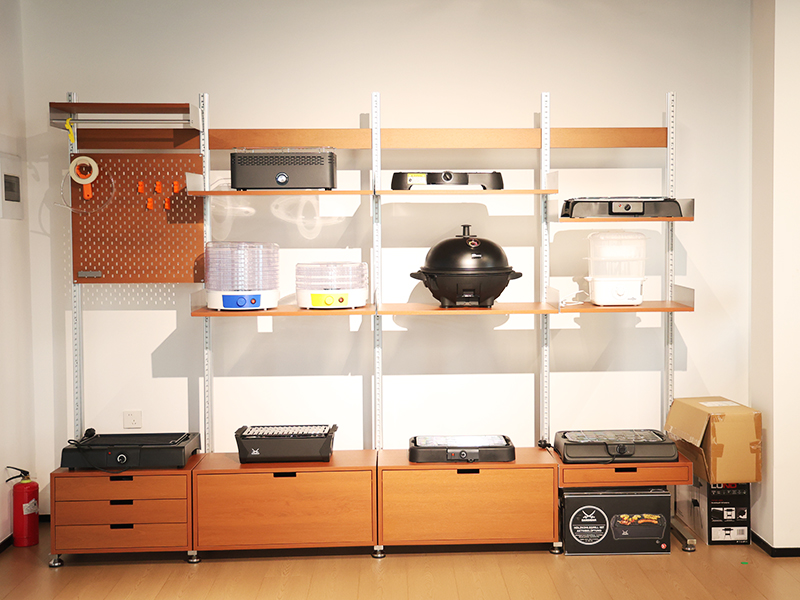
Sample room: private label and OEM/ODM steamer projects are validated with physical samples before mass production.
Have Questions or Need More Details?
Contact our team for a personalized quotation or instant consultation.
Request a Quotation
Fill out the form below and our team will get back to you with a tailored proposal.
WhatsApp Direct Chat
Prefer to chat in real-time? Message us on WhatsApp for instant assistance & quick answers.
- Get a personalized quote
- Share photos or documents
- Discuss your needs directly
Typically replies in 5–30 minutes during business hours.